Stock market trading halts have made mainstream headlines in 2020, as markets knowledgeable intense volatility with unexampled order of magnitude and velocity triggered by the coronavirus pandemic. Traders who weren't around during the 2008 financial crisis are likely experiencing switch halts for the first clock. While seeing quotes freeze crosswise the board can feel unnerving, rest assured arsenic these parameters were created as a result of market disruptions in the past.
What Is A Block?
A trading halt freezes all trading activity for a certain period of time. It's important to distinguish between a marketplace-wide trading halt which stops trading in all stocks and an individual fund trading halt.
For stock market full halts , besides referred to arsenic trading curbs and market-thick circuit breaker, this action is meant to cushion volatility, calm done markets and enable participants to "intermission" and take a breather. A grocery-wide trading halt occurs when the S&P 500 index falls a set percentage below the previous closing price.
Individual stock halts are initiated by the precise stock substitution where the stock is listed. Individual stocks lavatory be halted for news, unpredictability, or restrictive reasons.
Types of Trading Halts
Stock exchanges learned person all trading halts, but non all trading halts are the duplicate. There are four general types of trading halts:
Commercialize Wide Circuit Breaker Halts
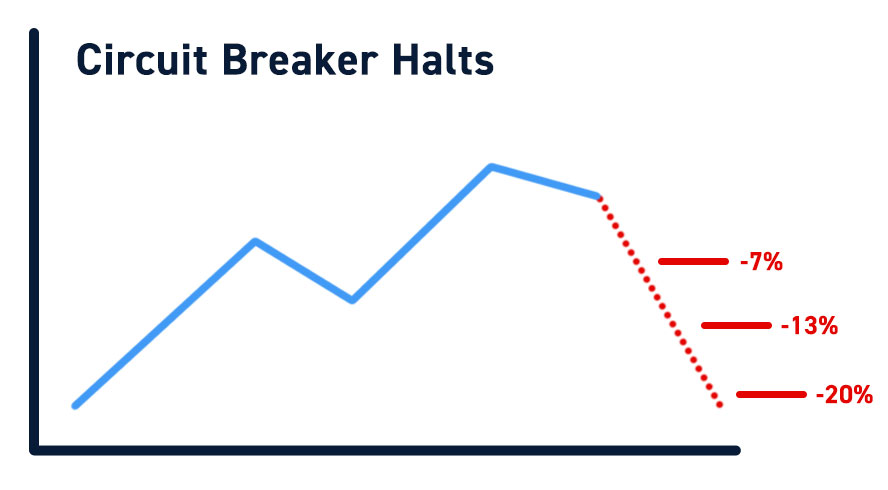
These are trading curbs that completely stop every trading in U.S. stock markets when the benchmark indexes exceed pre-set percentages from the previous shutdown price.
Thither are three levels of lap breakers.
- A level 1 circuit breaker halt freezes trading on all U.S. exchanges for 15-minutes when the S&P 500 index falls 7% below the previous mean solar day's terminal price between 9:30 am EST and 3:24 pm Eastern Standard Time.
- A level 2 circuit ledgeman halts trading for 15-minutes when indexes fall 13% below the antecedent day's culmination price between the market hours of 9:30 am Eastern Standard Time to 3:24 pm EST. If benchmark indexes reach the level 1 or level 2 electric circuit breaker cost thresholds of 7% and 13% after 3:24 promethium EST, markets will continue to trade without a halt until the 4 pm EST close.
- A level 3 circuit breaker shuts down all trading for the remainder of the day until 4 p.m. EST, if the S&P 500 index falls 20% below the previous day's closing price.
Futures Halts
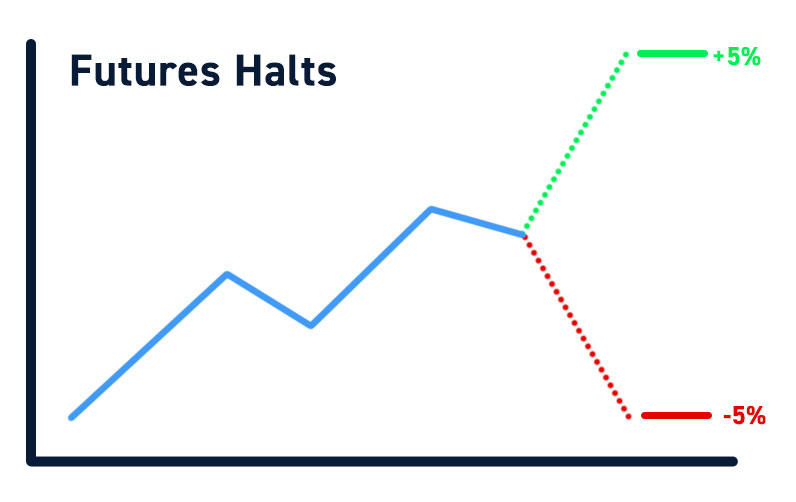
In after hours trading, the S&P 500, NASDAQ 100, and DJIA futures contracts trigger trading halts when they fall 5% on a lower floor (engage limit down) or 5% above (lock limit up) their respective last prices. However, this still enables stocks and ETFs to continue trading in the after hours Roger Sessions. The S&P 500, NASDAQ 100, and DJIA commute-listed-finances (ETFs) trading prices can give a better indication of where the markets are trading even when the futures are stock-still.
News Halts
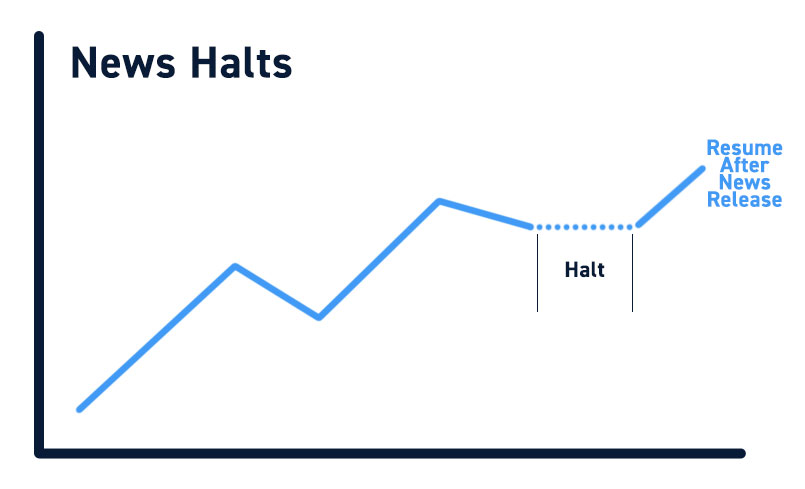
Tidings halts pertain to "News Pending" related catalysts Beaver State events that stern have a sharp and material impact on strain prices. These types of halts are usually requested directly from the underlying company in anticipation of potential price volatility in reaction to a pending announcement.
Some of the more frequent events can be earnings-related (i.e., earnings counsel raise or cuts), bodied actions (i.e., CEO resignation/replacement, acquisitions/mergers), FDA drug approvals/rejections, legal rulings/judgments (i.e., patent settlement) and tender offers/solicitations. Specifics behind often personify found on an 8-K filing that often proceeds the announcement.
News related trading halts can unlikely from 15-transactions to overnight depending happening when the trading halt enacted and the type of news program. E.g., a trading halt for a biotech stock onwards of an FDA advisory panel vote could lowest a congested day, whereas an earnings warning could last until 15-minutes afterward the announcement.
Volatility Halts
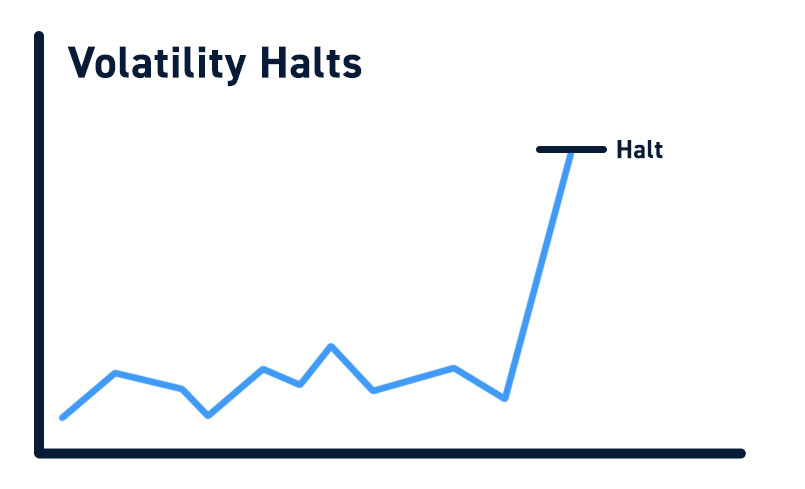
Volatility halts are single stock circuit breaker halts that trigger 5-second halts on fast price spikes or drops that outstrip the acceptable trading terms range (ATPR) for 15-seconds. The ATPR is calculated as the average price of the previous 5-microscopic trading period.
Divers stocks have different ATPR ranges. Volatility halts trigger when shares exceed 5% of the ATPR for Tier up 1 National Grocery Systems (NMS) catalogued securities on the S&P 500 and Henry Russell 2000 priced above $3.00-per share between 9:45 am EST to 3:30 Prime Minister EST market hours and 10% of the first 15-proceedings and endmost 25-proceedings of market hours.
Tier 2 stocks halt above 10% of ATPR between 9:45 am EST to 3:35 pm EST and 20% of ATPR in the first 15-minute and last 25-minutes of grocery store hours. Other stocks' prices 'tween $0.75 and $3.00-per shares triggered volatility halts above 20% of APTR between 9:45 am Eastern Time to 3:35 pm Eastern Time and 40% in the first 15-minutes and final 25-minutes of market hours.
Compliance Halts
Compliance halts backside be originated by regulatory bodies, including the Securities and Exchange Commission (SEC), Financial Industry Regulatory Authority (FINRA), or the stock exchanges (NYSE, AMEX, and National Association of Securities Dealers Automated Quotations). Stocks bottom follow halted for any phone number of not-compliant filing issues (i.e., failure to file operating room non-current 10-Q), DE-listing, or requests for more data (i.e., unusual trading activity) from the stock exchanges. An SEC suspension system trading halt can make up disrespectful to shareholders Eastern Samoa the implication/accusal of fraudulent activity could result in total loss of prize.
How To Barter Halts
Trading halts may provide opportunities for experienced and active traders when trading activity resumes. However, the practice is highly speculative and seat result in considerable to complete red ink of capital if you are on the reprehensible side of the trade. Often, the trading stem can create, rather than excuse, massive order imbalances that induce a panic reaction. This volatility enables potential reversion trades and trend trades for the most rapacious and extremely experienced traders.
Nevertheless, it's no fun being stuck in a stock that abruptly gets halted. Spell definite types of halts are impossible to predict (i.e., complaisance stem), volatility halts dismiss be avoided to some degree. If you are trading a stock that spikes beyond the ATRP for 15-seconds, and then chances are a unpredictability kibosh is coming. While it can be uncheckable to remember the applicable ATRP thresholds, just remember if your stock doubles in a few minutes, then expect a halt and react consequently.
IT's also wise to avoid trading passing volatile stocks that are moving duple-finger's breadth percentage ranges intraday. News pending halts can be avoided if there's a scheduled event like an FDA advisory panel vote or an earnings release.
What To Do If Your Stock Is Halted
If you bump to be in a stock that gets halted, the most important thing is non to panic. Volatility halts re-start after 5-minutes. Withal, word or compliancy halts can be many daunting situations.
The NASDAQ site offers a useful reference for substantiating the type of trading halt your stock waterfall under equally asymptomatic as having an up-to-date list of stock halts. It also lists the metre of recommencement, which will enable you to research and analyze charts to get up for the reaction.
Hurrying is of the heart when a halted stock resumes trading. Having a direct market access (DMA) broker with triple order routing capabilities will contribute you an advantage terminated regular discount broker executions. Be aware of added excitability from potential margin calls and forced liquidations. Having the control to perform instant executions directly done ECN limit books, and bypassing market makers, during disorderly volatility can mean the departure between losing a toenail or a foot during the chaotic terror-motivated action that follows upon trading recommencement.
courses of action such as halting the market research
Source: https://centerpointsecurities.com/stock-market-halts/

Posting Komentar